


June 03, 2026
Why can’t some people stand their progressive lenses?
The classic:
“I can’t stand my progressive lenses.”
This phrase comes up frequently in the world of optometry. Yet progressive lenses are now one of the most effective solutions for correcting distance, intermediate, and near vision.
So why do some people struggle while others adapt in just a few days?
Contrary to popular belief, the problem isn’t always the lenses themselves. In many cases, discomfort is related to the way measurements are taken, how the lenses are centered, the choice of frames, or the guidance provided during the fitting process.
In some cases, an error in the prescription may also explain difficulties in adjusting to the glasses.
That is why eyeglass manufacturers offer an adjustment guarantee, typically lasting two months.
This period allows the optician to support the customer, check the glasses, and ensure that every setting contributes to comfortable vision.
At The House of Eyewear, an optician specializing in progressive lenses in Paris, we’ve found that a successful pair of glasses depends on much more than just the choice of lenses.
Progressive lenses are a precision technology
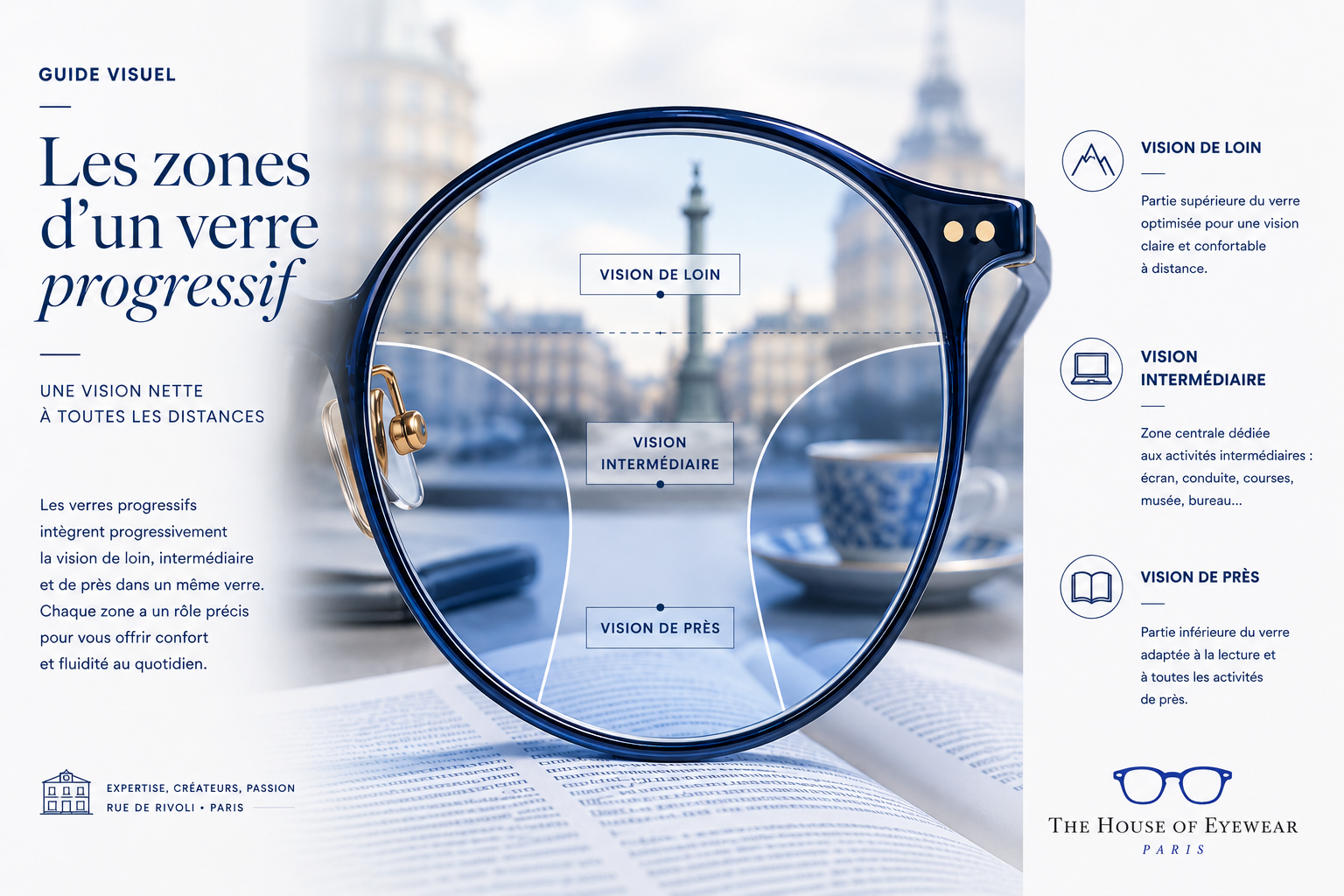
Progressive lenses allow you to see clearly at all distances without changing glasses.
They combine distance vision, intermediate vision, and near vision in a single lens. This technology provides remarkable comfort in everyday life, provided that the lenses are perfectly tailored to the wearer.
To get the most out of their performance, every detail counts.
The prescription, of course, but also the position of the eyes, the shape of the frames, natural posture, and visual habits.
Not all adjustment difficulties stem from the glass
When someone experiences discomfort with their progressive lenses, they often think the lenses aren’t right for them.
However, the reality is often more complex.
Progressive lenses are the result of a combination of factors that must work together. When any one of these factors is suboptimal, visual comfort can be affected.
The most common causes are:
- inaccurate centering;
- incomplete measurement;
- ill-fitting frames;
- a correction that requires verification;
- an adjustment period that is too short.
That is why it is essential to analyze all of the equipment before drawing any conclusions.
Why is centering so important?
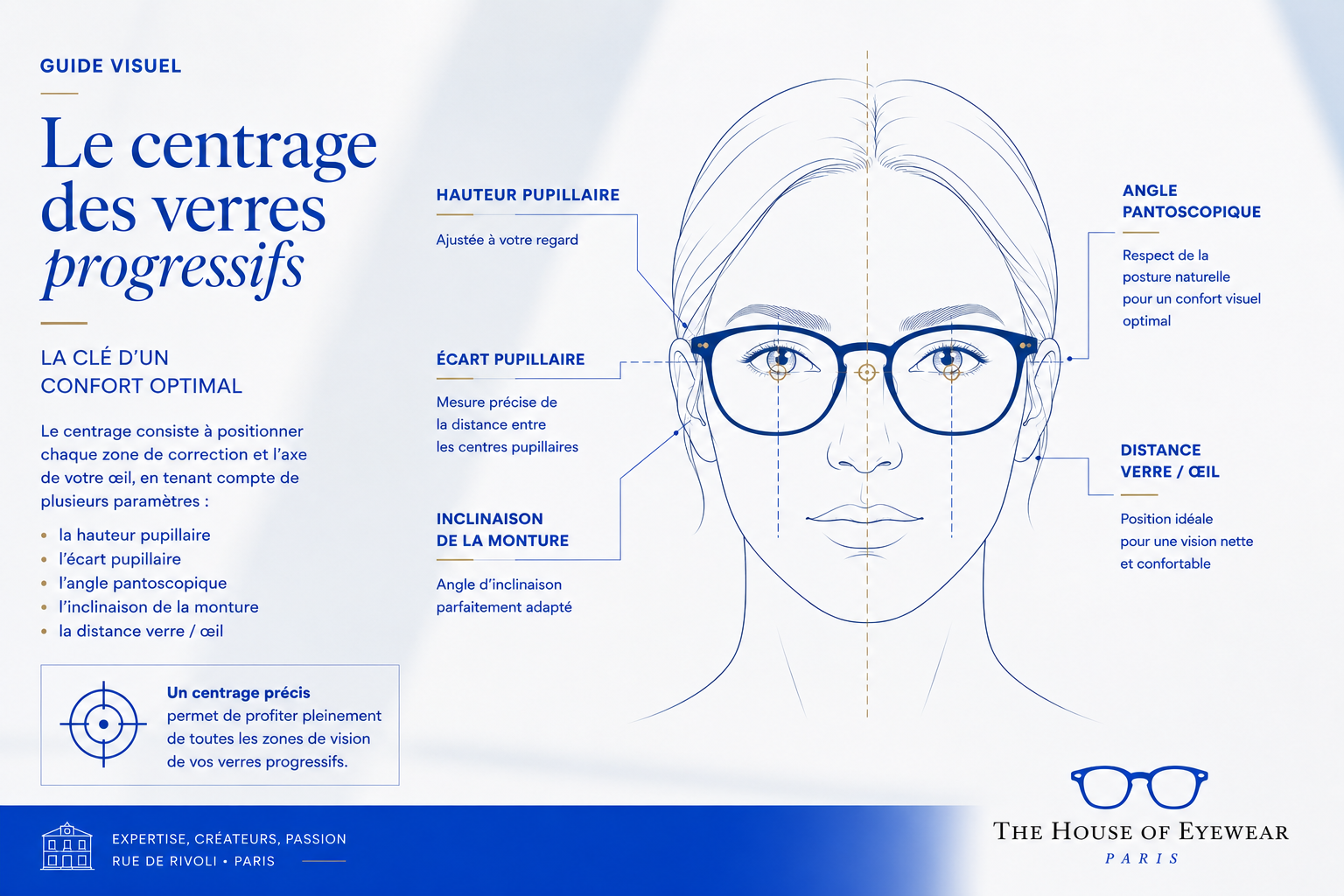
Centering involves precisely positioning the different areas of the lens in front of the wearer’s eyes.
This step is particularly important when it comes to progressive lenses.
Just a few millimeters can be enough to change the visual experience.
Poor centering can cause blurred vision, eye strain, or excessive head movements.
This is often one of the first things checked when a wearer has trouble adjusting to the device.
There are different ways to center something.
Today, opticians have several methods at their disposal for taking measurements.
Some stores primarily use digital measuring columns capable of recording a wide range of technical data.
These tools provide accurate information and are a valuable resource when selecting equipment.
At The House of Eyewear, we have chosen to perform manual centering using a pupillometer, a ruler, and a centering pen.
This method requires more time and genuine expertise. It also allows you to examine factors that contribute to the overall comfort:
- natural posture;
- head posture;
- the actual position of the mount;
- visual habits;
- facial structure.
For us, technology and human expertise are not mutually exclusive.
Technology measures. The optician interprets.
It is this combination of precision and experience that makes it possible to customize progressive lenses.
The right frames improve the comfort of progressive lenses
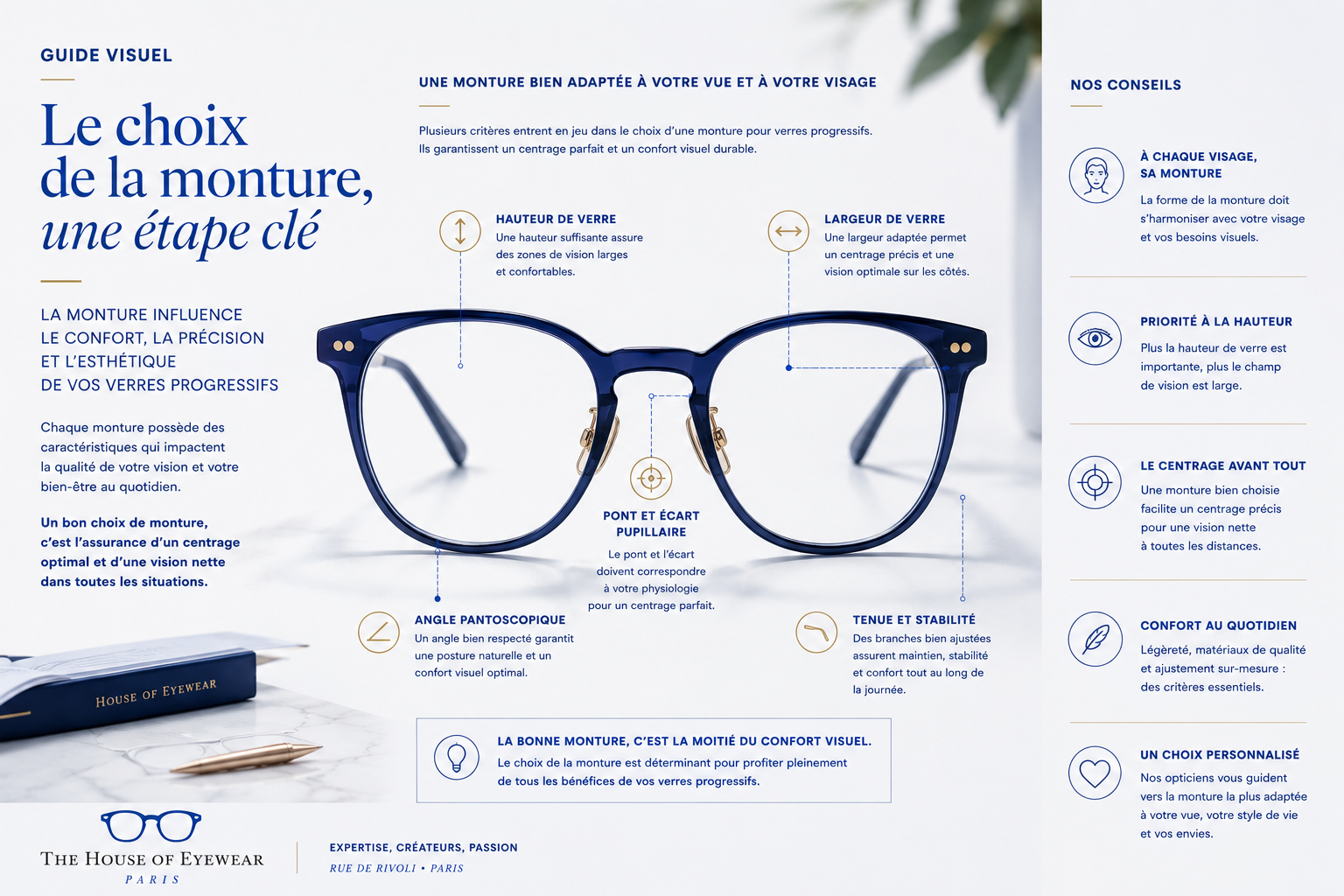
The choice of frame plays a key role in the success of a piece of equipment.
Not all frames are suitable for all progressive lenses.
A frame that is too small can limit certain areas of vision. Conversely, a well-chosen frame allows you to take full advantage of the lens’s performance.
Aesthetics are important.
Comfort is just as important.
At The House of Eyewear, we are always striving to strike a balance between style, ergonomics, and visual performance.
Adaptation is part of the process
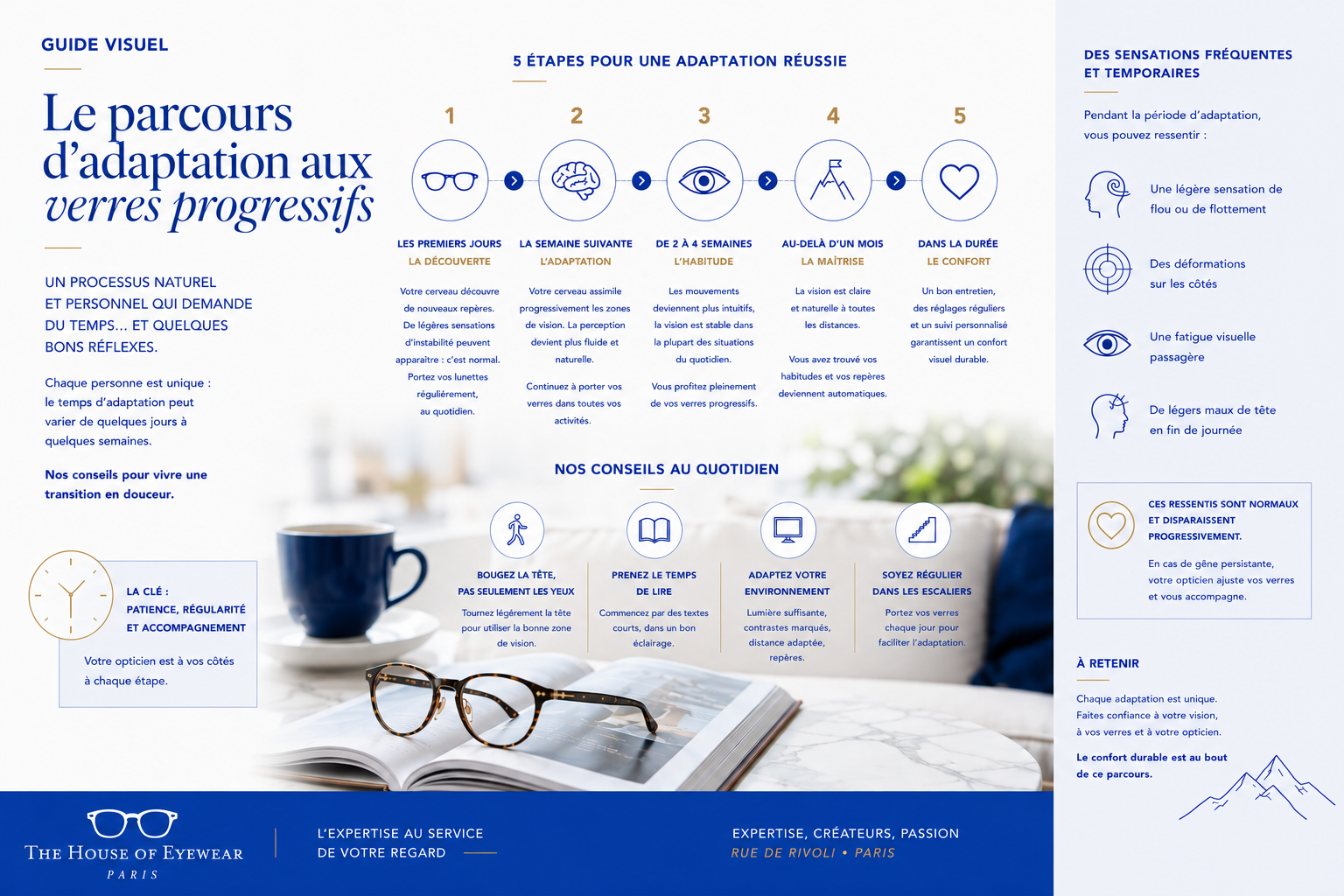
Even when the equipment is perfectly made, a short adjustment period is to be expected.
The brain must learn to use the different areas of vision provided by the lens.
Some people adjust within a few hours.
Others will need several days or a few weeks.
This learning phase is perfectly normal and should not be interpreted as a failure of the equipment.
During this time, it’s important to wear your glasses regularly to help your eyes adjust.
The support provided by the optician often makes all the difference
The process of getting progressive lenses doesn’t end with receiving the glasses.
Fitting the frame, providing usage advice, and follow-up care are an integral part of the process.
Sometimes, a simple adjustment can significantly improve visual comfort.
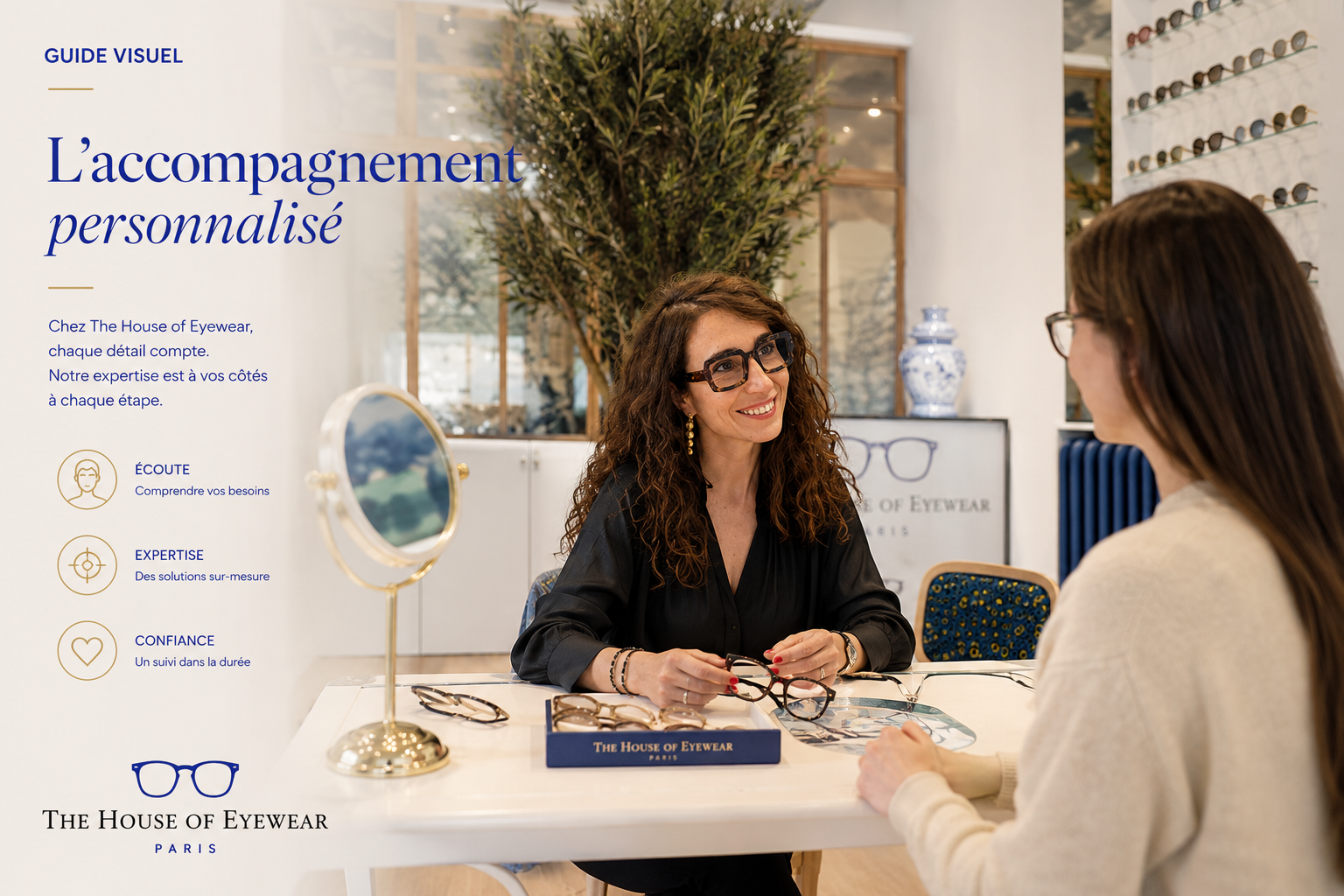
At The House of Eyewear, we support our customers before, during, and after the delivery of their eyewear.
Because a good pair of progressive lenses is about more than just the technical specifications.
It should be tailored to the way you live, work, read, and view the world.
Behind every piece of equipment, there is a person
Progressive lenses have evolved significantly in recent years. Today’s technologies provide remarkable visual comfort and clear vision at all distances.
However, technology alone is not enough to guarantee a successful experience.
Two people with the same prescription will not necessarily experience the same adjustment. Each person has their own habits, lifestyle, posture, and expectations.
That is why the success of a phased implementation can never be completely standardized.
Beyond measurements and technical specifications, the most important thing is to understand the person who will be wearing the glasses every day. Behind every pair of glasses lies a process of discussion, observation, and a genuine understanding of visual needs.
This human touch transforms a technical solution into a truly personalized one.
Because, in the end, the best equipment is often the kind you don’t even think about anymore.
FAQ – Adjusting to Progressive Lenses
Why am I having trouble adjusting to my progressive lenses?
Several factors may play a role: centering, choice of frame, visual habits, prescription, or simply the adjustment period.
How long does it take to get used to progressive lenses?
Most wearers adjust within a few days. Some people may need two to three weeks.
Can poor alignment affect vision?
Yes. A difference of just a few millimeters can have a significant impact on the visual comfort and effectiveness of progressive lenses.
Are all frames suitable for progressive lenses?
No. Some shapes and sizes are more suitable than others. Choosing the right frame is an integral part of ensuring the success of the equipment.
Why choose a progressive lens specialist?
Because high-performance progressive lenses depend just as much on the quality of the lens as on the accuracy of the measurements, the centering, and the support provided.